Substack ·
Why so many marketers miss the mark with social media
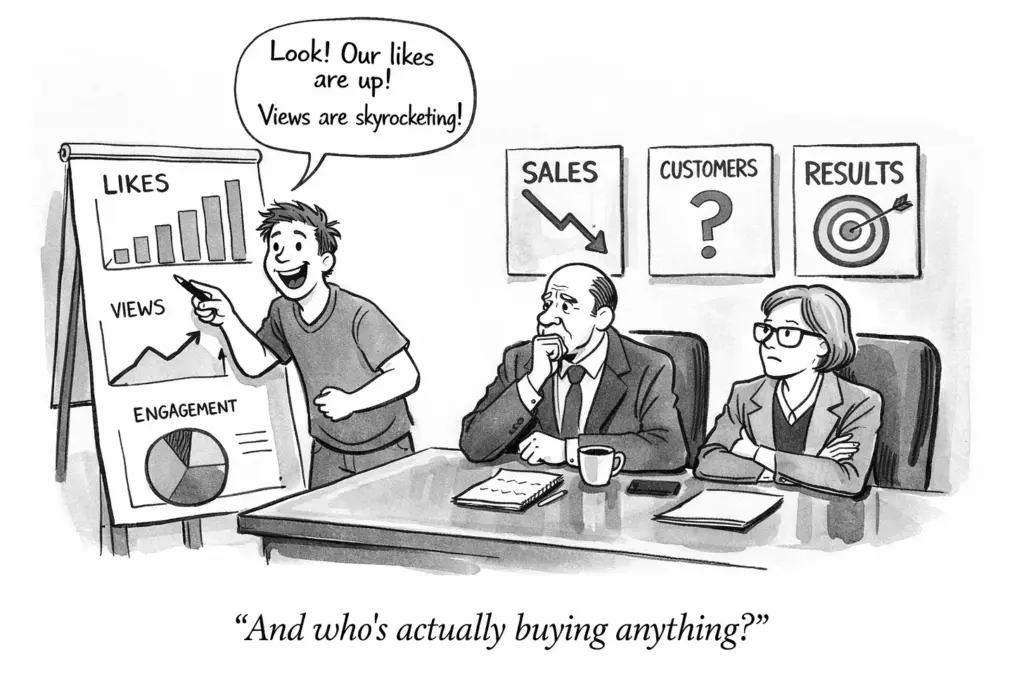
Most marketers don’t fail at social media because they misunderstand the platforms. They fail because they mistake visibility for progress and activity for strategy.
Social media is powerful. It’s fast, culturally central, and built to deliver immediate feedback. You post something and the world responds. Numbers move. Dashboards light up. That responsiveness is intoxicating, especially early in a career, because it creates the feeling that something is happening.
The problem is that feedback is not the same as results.
Marketing doesn’t begin with posting. It begins with decisions. Decisions about what is being sold, who it’s for, what problem it solves, and what needs to happen next for the business to move forward. Those questions are rarely exciting, but they determine whether anything downstream will matter.
When that work is skipped, social media quietly becomes the strategy by default. Posting becomes the plan. Engagement becomes the goal. Over time, marketing drifts away from helping a business get chosen and toward performing well inside the platform itself.
Social media doesn’t cause this drift. It simply makes it easier to ignore it.
One of the most common errors is treating engagement as intent. Likes, shares, comments, and views are read as signals of interest, and interest is assumed to lead naturally to action. In reality, engagement is ambiguous. People engage for reasons that have nothing to do with buying. They like things they don’t want. They share things they’ll never act on. They comment out of habit, identity, or disagreement. None of that guarantees movement toward a decision.
Engagement tells you that something registered. It does not tell you that anything changed.
The harder question is always behavioral. Did uncertainty decrease? Did understanding improve? Did someone move closer to choosing? If the answer isn’t clear, the metric doesn’t mean much, no matter how impressive it looks.
Storytelling often gets pulled into this same trap. Story works because it’s how people make sense of change. A good marketing story helps someone imagine themselves on the other side of a decision, with a problem reduced, a risk avoided, or an outcome improved. It doesn’t just express values or identity; it guides choice.
But storytelling without direction becomes decoration. It can sound smart, feel aligned, and generate plenty of engagement while still going nowhere. When stories aren’t anchored to a clear strategy and a defined next step, they entertain without converting. The issue isn’t creativity. It’s that the story isn’t doing the job marketing requires of it.
Platforms themselves don’t help. Social systems are designed to reward activity: frequency, novelty, reaction. They don’t reward clarity, restraint, or long-term credibility. As a result, marketers are nudged toward producing more rather than deciding better. The algorithm encourages motion, not judgment.
The marketers who miss the mark are often working hard. They’re posting consistently, tracking metrics, and responding to feedback. What’s missing isn’t effort or intelligence. It’s a clear line between attention and outcome.
Good marketing treats social media as distribution, not definition. The strategy lives upstream. The story has a destination. The metrics are tied to something real: leads, revenue, retention, growth. Social media supports that work. It doesn’t replace it.
When marketing works, social media feels quieter. There’s less obsession with numbers that don’t matter and more focus on whether the right people are moving in the right direction. The work becomes less performative and more accountable.
That shift is uncomfortable, because it removes the illusion of progress and replaces it with proof. But it’s the difference between being visible and being chosen — and it’s where social media finally starts to earn its keep.