Local News Matters ·
Coastal waters from Mendocino to Bay Area turning into a graveyard for gray whales
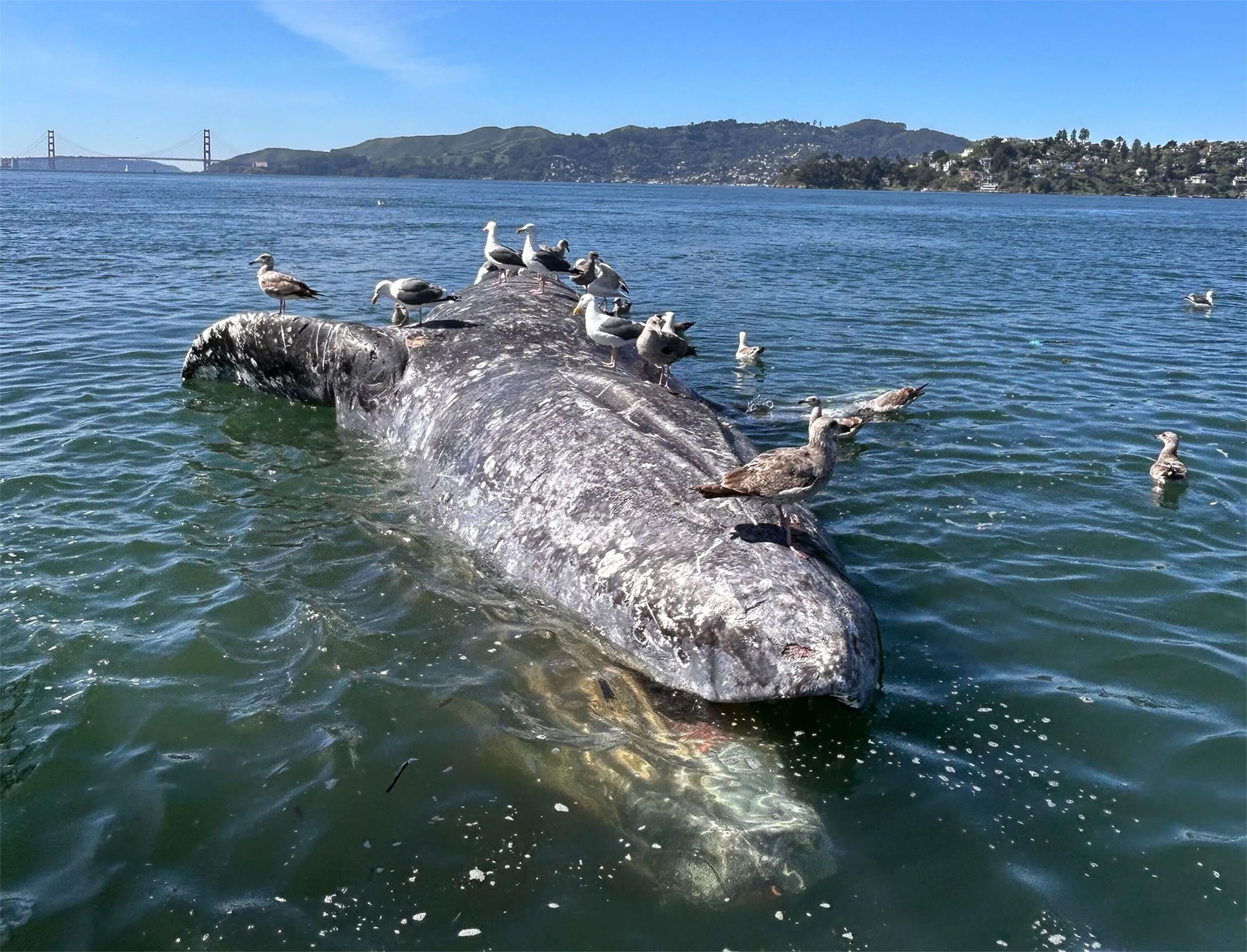
A deceased adult male gray whale discovered on RCA Beach had traveled past Tiburon on March 28 before passing through the Golden Gate on April 1 and washing ashore in Bolinas. The following afternoon, specialists from the Marine Mammal Center and California Academy of Sciences arrived with equipment to conduct a necropsy, searching for evidence of trauma before the tide returned.
Maggie Martinez, a veterinary pathologist, examined the gastrointestinal tract to determine what the whale consumed and whether it had encountered any algal bloom toxins. She also collected tissue samples including blubber and muscle to investigate potential trauma.
Two weeks prior, researchers had performed similar procedures on an adult female specimen at Angel Island, later categorized as a suspected vessel strike fatality. By Earth Day, no fewer than nine gray whale carcasses had surfaced in Bay Area waters during 2026, potentially surpassing the previous year's count of 24 deceased whales — 21 being gray whales — marking the highest number documented in 25 years.
A recently published study in Frontiers in Marine Science by Sonoma State graduate student Josephine Slaathaug and collaborators from the Marine Mammal Center and California Academy of Sciences revealed that at least 18% of gray whales entering San Francisco Bay since 2018 have perished there. Of those with confirmed causes, more than 40% showed vessel trauma evidence, with 60% of thoroughly examined specimens displaying strike signatures. Researchers suggest actual mortality figures may approach 50%.
"Gray whales maintain a low profile when surfacing, making detection difficult in foggy conditions typical of San Francisco Bay," Slaathaug noted. "Additionally, the highly trafficked waterway and the Golden Gate Strait's bottleneck position create dangerous concentrations."
Bekah Lane from the Center for Coastal Studies emphasized that "vessel traffic represents the primary threat to these whales" and that "route modifications and velocity limitations have demonstrated substantial effectiveness in reducing large whale strike mortality."
Despite scientific consensus supporting speed restrictions, such measures remain voluntary along California's northern coast. A 2007 study in Marine Mammal Science established that at 8 knots, strike fatality risk is approximately one-in-six; at 15 knots, fatality becomes nearly certain. NOAA instituted mandatory 10-knot zones around Eastern North Atlantic right whale habitats in 2008, achieving 80-90% reduction in fatal strikes. California's voluntary speed-reduction initiative has decreased blue and humpback strike deaths by only 9-13%.
The expansion of California's Vessel Speed Reduction zone under Assembly Bill 14 now encompasses the entire state coastline, including migration corridors off Mendocino and Sonoma County, where gray whales transit twice yearly. Fifty-two shipping companies participated in 2026, up from 44 previously, though participation outside designated zones remains inconsistent and non-compliance carries no consequences.
The federal regulatory framework for San Francisco approaches has remained in legal uncertainty since 2022, when a court invalidated NOAA's biological determination that existing shipping lanes posed no whale or turtle risk. The requisite replacement analysis has yet to materialize after three years. In October 2025, the Center for Biological Diversity and Friends of the Earth initiated a second lawsuit against NOAA and the Coast Guard.
The Coast Guard's Vessel Traffic Service operates San Francisco's primary real-time whale response system. When cetaceans are reported, VTS broadcasts locations to commercial vessels and requests velocity reduction. Ferry operators can reroute around whale concentrations, but container ships remain restricted to deep-draft channels.
Gary Reed, VTS San Francisco director, explained: "Large ships face constraints by their draft. Establishing different channels would demand billions in dredging expenditures." The operation runs with existing personnel and depends on whatever data bridge officers or shore-based researchers voluntarily communicate.
Representative Sam Liccardo introduced the Save Willy Act on Earth Day, proposing four-year pilot funding for a dedicated Cetacean Desk within VTS San Francisco with up to two full-time positions. This desk would aggregate real-time information from NOAA, the Coast Guard, state agencies, research institutions, tribes, and commercial and recreational vessels.
"Researchers monitor these whales regularly, but we can multiply their reach by gathering information from the substantially greater number of commercial and recreational boats operating on the water," Liccardo stated. The initiative would establish a centralized notification system, though it addresses coordination rather than implementing mandatory velocity controls.
Giancarlo Rulli, Marine Mammal Center associate director of public relations, argued the gray whale's documented adaptability may be deteriorating. "It endured a mass mortality episode around 1999-2000 and recovered, only for another to emerge 20+ years later," he noted. "However, recovery since then hasn't matched the prior rebound."
NOAA's latest population assessment estimates Eastern North Pacific gray whales at approximately 13,000 — down from 27,000 in 2016, the minimum since the 1970s. The 2025 calf production reached only 85, the lowest on record since documentation commenced in 1994. The Center for Biological Diversity's October complaint referenced "roughly 80 whales killed annually by vessel strikes on the West Coast."
Gray whales undertake one of the longest migrations among mammals — a 12,000-mile yearly round trip between Arctic feeding zones and Baja California breeding areas. During the northbound migration from February through May, numerous animals arrive undernourished. Researchers extracting specimens from San Francisco Bay theorize these whales are seeking emergency provisions, with the Bay's anchovy populations and invertebrate-rich sediments attracting them.
Rulli acknowledged the Center is working to increase water-based monitoring capacity and investigating whether location-tracking equipment might be attached to individual specimens. "Tracking devices typically used for endangered species at our Sausalito facility cost between three and five-plus thousand dollars each," he explained. "Resource limitations are crucial considerations. When operating with limited nonprofit funding, supplementary support for investigation and protective interventions becomes essential."
Absent mandatory regulations, Marine Mammal Center Director of Cetacean Conservation Biology Kathi George has established Whale Smart, a vessel-operator education initiative launched in February alongside the San Francisco Harbor Safety Committee's Marine Mammal Subcommittee. The program distributes instructional videos to professional maritime operators covering whale-behavior recognition, blow identification, and velocity reduction during conditions conducive to strikes.
"Every measure undertaken in San Francisco Bay carries significance," George stated at the program's launch. "Whale Smart furnishes mariners essential information for protecting whales while sustaining secure and productive activities when the species most requires assistance."
Moe Flannery, California Academy of Sciences senior collections administrator and study co-author, conveyed the urgency: "An immediate crisis demands resolution, and this investigation represents merely the starting point in gathering science required to guide this species' conservation and administration."
After specialists recovered the whale's ear plug — permitting age estimation — and secured their specimens at RCA Beach, the carcass was surrendered to the tide. Forty feet of evidence returned to the Pacific waters from which the whale had emerged to enter the bay.
The study documented 114 distinct individuals in San Francisco Bay between 2018 and 2025. Only four appeared in multiple years. Researchers determined most utilize the Bay as emergency feeding stops — dangerous ones at that.